
2026 marks the semiquincentennial (literally “half of five centuries”) of the Declaration of Independence, the founding document of the United States of America. A half century ago, as America was celebrating its bicentennial, a remarkable new era in space exploration was about to begin.
Although the space race to land humans on the Moon had concluded a few years earlier with NASA’s highly successful Apollo program, the US and USSR continued to engage in a technical competition to explore the solar system with robotic spacecraft.
On June 19, 1976, NASA’s Viking 1 spacecraft entered orbit around Mars. Viking 1’s lander was originally scheduled to set down on the surface on July 4 to coincide with the bicentennial celebration, but new imagery of the originally selected landing site indicated that it was too rough to touch down there, so mission planners had to select a more suitable landing site, and on July 20, the seventh anniversary of the Apollo 11 lunar landing, Viking 1 touched down in Chryse Planitia.
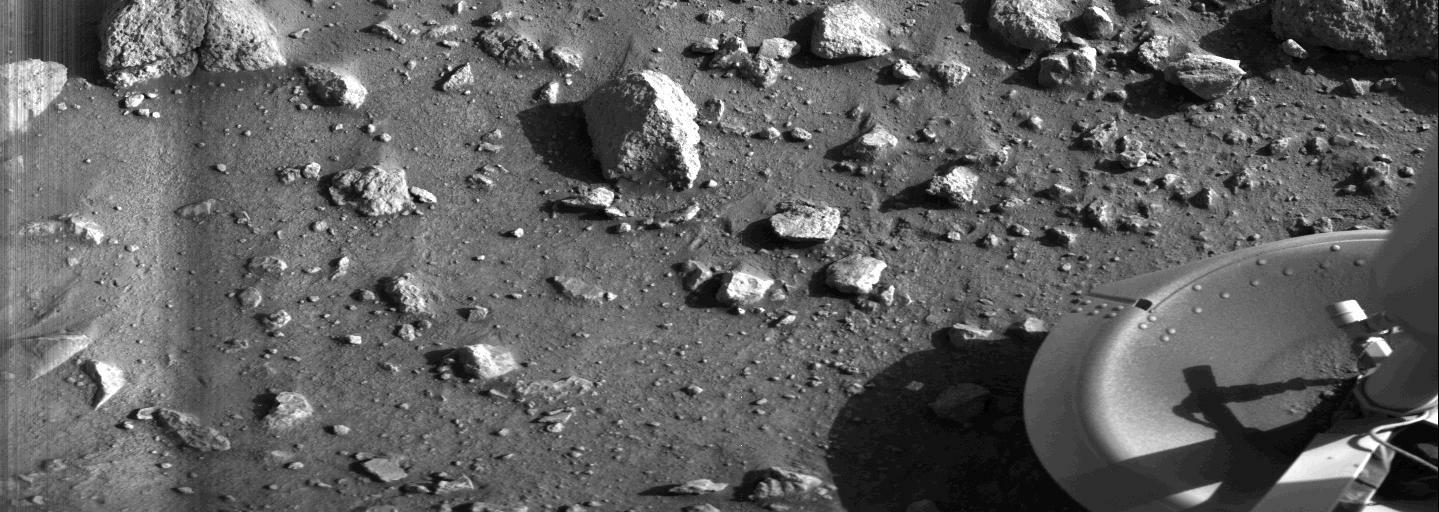
One of the most anticipated moments in the history of planetary exploration occurred immediately after as scientists at the Jet Propulsion Laboratory gathered around monitors to watch the first black-and-white image of the Martian surface, rendered line by line from data that took 28 minutes to reach Earth.
Humanity’s first ever view of the surface of the red planet ended millennia of wonder and speculation as the complete image showed fine-grained sand and rough-edged rocks ranging from millimeter sized pebbles to several centimeters.
Viking 2 landed on Utopia Planitia, on the opposite hemisphere of Mars than Viking 1, on September 3, 1976.
Together, the twin rovers remained operational on the surface until 1982 and 1980, respectively, and not only returned 4,500 images, but also provided geologic and seismological data, operated as weather stations, and studied soil samples taken from their respective landing sites for biochemical signatures, which turned out to be inconclusive.
Viking 1 wasn’t the first spacecraft to soft-land on Mars. It was preceded four and a half years earlier by the USSR’s Mars 3 probe, but that mission was considered only a partial success, as contact with the lander was lost within two minutes of touchdown, and the probe’s only returned image showed no discernible surface features.
After Viking’’s mission concluded in November 1982, it would be nearly 15 years before the next attempt to land a craft on the Red Planet.
NASA’s Mars Pathfinder, which would pioneer not just a new airbag soft landing method, but also was the first spacecraft to deliver a small rover, called Sojourner, to explore its landing site. Exactly 21 years after the originally-scheduled landing of Viking 1, NASA would finally achieve its Independence Day landing as Pathfinder touched down on July 4, 1997 in Ares Vallis, an area that shows signs that it may have been an ancient river bed..
Sojourner, the tiny 10 kg rover, rolled off a ramp of the Pathfinder lander on July 5, and spent 85 days (83 sols) traversing a total of 100 meters on Mars, but never straying more than 12 meters from its parent craft. It carried out experiments in navigation, materials science, geologic composition, and power attenuation due to dust accumulation.
Following the success of Sojourner, NASA embarked on the ambitious Mars Exploration Rovers (MER) program, with two identical 185 kg rovers landing on Mars, employing the airbag soft landing method used by Pathfinder.
Spirit was the first to land, on January 4, 2004, in Gusev Crater. Opportunity landed three weeks later in Meridiani Planum. Carrying a suite of instruments to analyze the geology and chemistry of Mars, and with the important capability of sampling disparate sites separated by considerable distance, the solar powered rovers far surpassed their 90-day design life. The rovers satisfied one of their primary mission goals within weeks of landing by revealing definitive evidence that liquid water had once flowed on the surface of Mars.
Spirit eventually suffered two broken wheels and got stranded on a slope, unable to recharge its batteries after a Martian winter
Opportunity, after spending an incredible 5,111 sols operating on the surface, succumbed to a dust storm, starving it of enough solar power to keep its batteries charged. NASA declared its very successful mission to be completed in early 2019, after the rover traversed an incredible distance of 45.16 km, about the distance from Seagrave Observatory to Newport.
As a fitting and emotional tribute, the 2022 documentary film Good Night Oppy chronicles the mission through the perspectives of the engineers and scientists at NASA’s Jet Propulsion Laboratory who kept it going.
While Opportunity was still actively roaming the surface of Mars, the flagship Mars Science Laboratory rover, named Curiosity, touched down in Gale Crater on August 6, 2012, using a new sky crane that hovered 20 meters off the surface and lowered the rover onto the surface directly onto its wheels. The 899 kg rover, powered by a radioisotope thermoelectric generator, is much larger, more robust, and designed to operate for a full year on Mars.
Mars 2020, named Perseverance, is a twin of Curiosity, but with improved capabilities and another new mode of exploration, a miniature autonomous helicopter. Perseverance landed in Jezero crater on February 18, 2021, and deployed its helicopter six weeks later.
The Ingenuity helicopter, designed to conduct five flights over 30 days, took to the Martian skies 72 times over its three-year mission, and flew a total of 17.0 km, accumulating 128.8 minutes of flight time.
Not to be overlooked, NASA also successfully landed two static spacecraft on the surface of Mars: Phoenix in 2008, and InSight in 2018. Phoenix detected subsurface ice near the Martian north polar cap, and InSight studied Martian weather as well as its interior, despite its drill not working as planned.
In May 2021, China joined Mars surface exploration with the Tianwen-1 mission, which deployed a lander named Zhurong, that roved the surface for 355 sols, traversing a total of 1.921 km.
As of mid-2026, the Curiosity and Perseverance rovers are still active and fully functional on Mars, with no planned end to either mission.
As we close out the first half century of Mars surface exploration, it is noteworthy that at least one spacecraft has been active on Mars for 58.2% of the time since Viking 1 first landed, and that and the presence of working spacecraft has been continuous since Spirit touched down on January 3, 2004.
The progression over the past few decades of sending more capable spacecraft to the surface of Mars was leading to the goal of eventually returning samples from Mars to Earth. As such, the Perseverance rover has been drilling and caching samples and placing them into titanium tubes and depositing them at designated pick up areas along its path. To date, 33 of 43 sample tubes have been cached, and 10 have been deposited at a “sample depot” area, awaiting a future mission. Unfortunately, the long-planned mission to retrieve and return the sample capsules left by Perseverance has been delayed indefinitely due to cost and schedule concerns. NASA has instead invited its industry partners to submit proposals for a lower cost mission to retrieve the samples. Given the pronounced lack of success to date of commercial ventures in landing payloads on the surface of the Moon, prospects for retrieving the Martian samples any time in the near future look grim.
So what does the future hold for Mars surface exploration?
We can expect several more years of continued exploration by the Curiosity and Perseverance rovers.
In 2028, NASA plans to launch Skyfall, a mission that uses a nuclear electric propulsion spacecraft called Space Reactor-1 (SR-1) Freedom to send three improved Ingenuity-class helicopters to explore the surface and scout potential locations for future human landings.
Tianwen-3, a Chinese sample return mission, is scheduled to launch in 2028, with samples being returned to Earth in 2031. Perhaps another space race would encourage NASA to revive plans for its sample return mission.
Also in 2028, ESA’s ExoMars rover Rosiland Franklin will launch to Mars with a drill and sampling experiments to analyze Martian soil for evidence of past or current life.
And in 2030, Indian Space Research Organization (ISRO) plans to launch its Mars Lander Mission.
Mars has undoubtedly been the busiest place in the solar system for robotic exploration during the past half century. With so much progress made over the past 50 years, where will we be in another 50? Will astronauts walk on the surface? Will definitive evidence of past life be found? If we continue the drive to explore our planetary neighbor, we’re bound to make some exciting new discoveries.
