
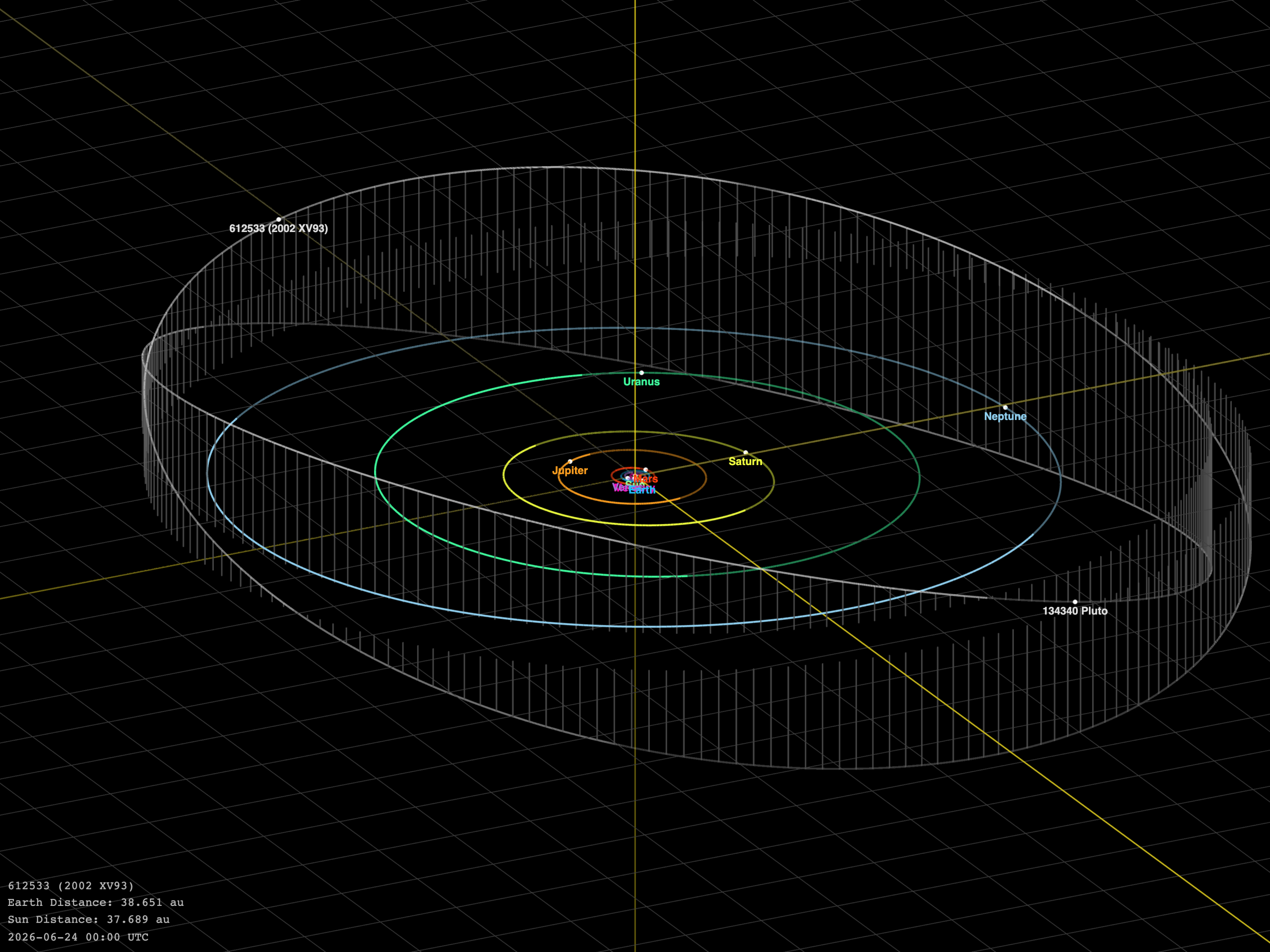
One of the joys of being an astronomy lover is that there’s always something new being discovered; there’s not much time around for us to be bored. As an example: Recently, attempts were made to determine the diameter of the small body 2002 XV93, within the area beyond the orbit of Neptune – the Kuiper belt – using the occultation method: watching it pass in front of a star, then measuring how long the star was behind the body. This time, the star didn’t “wink” out, as it should have, but slowly dimmed out for about 1.5 seconds before finally disappearing. In addition, it took the same amount of time for the star to fully reappear. This was observed by telescopes in three areas of Japan, leading all observers to believe they had witnessed an atmosphere surrounding the tiny body.
Located over 3 billion miles from the Sun, an atmosphere around such an object seems fairly improbable. First, the temperatures are so cold that any gases should have frozen and fallen upon the surface; in addition, 2002 XV93 is so small, barely 300 miles in diameter, resulting in its gravitational pull being so weak, that any air there should have floated into space long ago.
In trying to determine why this atmosphere, although very thin – believed to be just one to two ten-millionths of our own – could be present, one theory is that it could possibly have come from material caused by the eruption of ice volcanoes, or was formed from a recent impact of an even smaller object. It was even thought, and quickly dropped, that the dimming could have been caused by a ring around the body, but it would have been too close to the surface to cause the even result on both sides.
It is known that another trans-Neptunian body, Makemake, has a slight atmosphere, but Makemake is over twice the diameter of this tiny body, and it has wisps of methane around it. The James Webb Space Telescope was trained on 2002 XV93 to see if it also could have methane, or nitrogen or carbon monoxide on its surface, which could possibly turn to vapor, creating an atmosphere, but as of now, none have been detected.
All of which tends to make us love the science of astronomy: We never know what will be found next.
